Bone Graft After Tooth Extraction: Recovery Timeline and Tips
Written & Researched By
Editorial Team · product research desk
Sources: ADA guidelines, Mayo Clinic, PubMed, peer-reviewed dental literature
Published: May 26, 2026
Short answer: Bone graft healing after tooth extraction takes 3 to 6 months for the graft material to fully integrate with your natural bone. The soft tissue over the graft heals in 2-3 weeks, but the bone maturation happening underneath takes much longer. Most patients experience manageable pain for 3-7 days, with the first 48 hours being the most uncomfortable.
If your dentist placed a bone graft at the time of your extraction, you’re likely preparing for a dental implant down the road. The graft preserves the bone volume in your jaw that would otherwise shrink after a tooth is removed — giving the future implant a solid foundation. Understanding the recovery process helps you protect this investment. What the graft is and why it is placed is covered in bone graft after tooth extraction.
Why Bone Grafts Are Placed After Extraction
When a tooth is removed, the surrounding jawbone begins to resorb (shrink) almost immediately. Research in Clinical Oral Implants Research shows that the extraction site can lose 40-60% of its bone width within the first 2-3 years if no graft is placed.
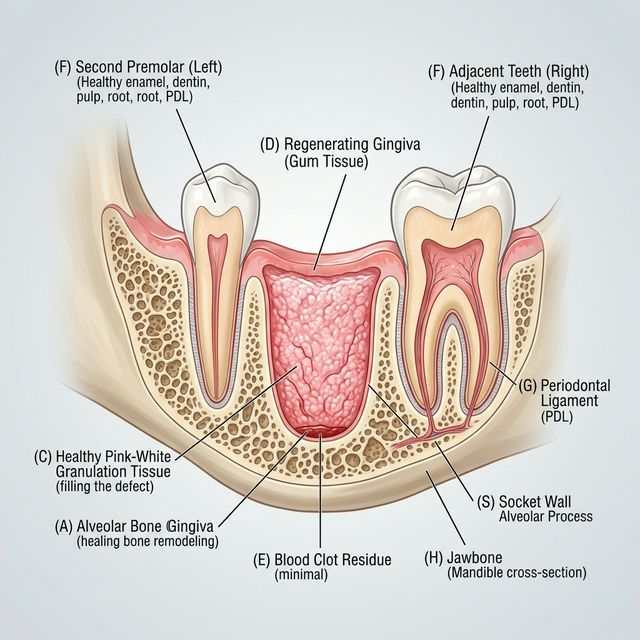
A bone graft fills the empty socket with graft material that serves as scaffolding. Your body gradually replaces this scaffolding with your own living bone through a process called osteoconduction. The result is a dense, stable ridge of bone that can support a dental implant.
Types of Bone Graft Material
Your surgeon may use one of several graft types, and the choice affects healing:
- Autograft — bone harvested from your own body (often the chin or back of the jaw). Highest success rate, but requires a second surgical site.
- Allograft — processed human donor bone. The most commonly used type for socket grafts. No second surgical site needed.
- Xenograft — processed animal bone, typically bovine (cow). Effective and widely used.
- Alloplast — synthetic bone substitute material. Various formulations exist, often calcium-based.
All four types have well-documented success rates for socket preservation grafts. Your surgeon will recommend the best option based on your specific situation.
The Bone Graft Recovery Timeline
Days 1-3: Acute Recovery
This phase is similar to standard extraction recovery, with some additions:
What to expect:
- Moderate to significant swelling, peaking at 48-72 hours
- Pain manageable with prescribed medication (often ibuprofen plus acetaminophen, sometimes with a short course of stronger pain relief)
- Some bleeding or oozing for the first 6-12 hours
- A membrane or sutures covering the graft site (your surgeon may place a collagen membrane over the graft material before suturing)
- Numbness from anesthesia lasting 2-5 hours
Critical care instructions:
- Apply ice packs: 20 minutes on, 20 minutes off for the first 24-48 hours
- Sleep with your head elevated on 2-3 pillows to reduce swelling
- Eat only soft, cool foods — avoid the graft side entirely
- No rinsing, spitting, or using straws for 24 hours
- Absolutely no smoking — nicotine dramatically impairs graft integration
Days 3-7: Initial Healing
What to expect:
- Swelling begins decreasing from day 3-4
- Pain shifts from medication-requiring to mild discomfort
- The surgical site may look white or yellowish — this is normal healing tissue, not infection
- Some patients notice small granules of graft material in their saliva — losing a few particles is common and usually not significant
- Sutures begin dissolving (if dissolvable type) or remain until your follow-up appointment
Care instructions:
- Begin gentle warm salt water rinses (1/2 teaspoon salt in 8 ounces warm water), 3-4 times daily
- Continue soft food diet — see our soft food meal plan for ideas
- Avoid brushing directly on the graft site; brush surrounding teeth gently
- No physical activity beyond walking (elevated blood pressure can disrupt the graft)
Weeks 2-4: Soft Tissue Closure
What to expect:
- The gum tissue over the graft closes and begins looking pink and healthy
- Pain is minimal to none
- Sutures have dissolved or been removed
- Swelling is resolved
- You may feel a firm ridge at the graft site — this is the graft material under the healed gum tissue
Care instructions:
- Resume gentle brushing of the graft area with a soft toothbrush
- Gradually return to normal diet, avoiding very hard or crunchy foods that could put excessive pressure on the graft area
- Attend your follow-up appointment so your surgeon can check the graft
Months 2-6: Bone Integration
What to expect:
- No visible changes from outside — all the action is happening inside the bone
- Your body is slowly replacing the graft scaffolding with living bone cells
- The graft area feels firm and stable
- No pain or sensitivity
Monitoring:
- Your surgeon will likely take an X-ray or CBCT scan around months 3-4 to assess graft maturation
- Once sufficient bone volume and density are confirmed, you’ll be cleared for implant placement
Pain Management After Bone Graft
Bone graft recovery tends to produce slightly more discomfort than a standard extraction because of the additional surgical work involved:
Medication Protocol
Most oral surgeons prescribe a combination approach:
- Ibuprofen (400-600mg every 6-8 hours) — reduces both pain and inflammation
- Acetaminophen (500-1000mg every 6-8 hours) — can be alternated with or taken alongside ibuprofen for enhanced relief
- Prescription pain medication — sometimes provided for the first 2-3 days for breakthrough pain
Taking ibuprofen on a schedule (not just when pain hits) during the first 48-72 hours keeps inflammation controlled more effectively than treating pain reactively. Follow your surgeon’s specific medication instructions — they override any general advice.
Non-Medication Pain Relief
- Ice packs for the first 48 hours (20 on, 20 off)
- Head elevation while sleeping and resting
- Avoiding physical activity that raises blood pressure
- Soft, cool foods that don’t require chewing near the graft site
For comprehensive pain management strategies, see our managing pain guide.
Signs of Bone Graft Failure
While bone graft success rates are high (over 90% for socket preservation grafts), knowing the warning signs of failure helps you seek prompt treatment:
Early Signs (First 2 Weeks)
- Graft material visibly falling out in large quantities (a few granules is normal; large amounts are not)
- The membrane becomes exposed and visible in the mouth
- Increasing pain after day 4-5 instead of continued improvement
- Significant swelling that returns after initially resolving
- Pus or cloudy discharge from the graft site
- Fever above 101°F (38.3°C) lasting more than 24 hours
Later Signs (Weeks to Months)
- Persistent pain or sensitivity at the graft site beyond week 3
- Sinus complications if the graft was in the upper jaw near the sinus cavity
- Insufficient bone volume on X-ray at the 3-4 month check
If you notice any of these signs, contact your oral surgeon. Early intervention can often save a compromised graft.
Smoking and Bone Graft Failure
This deserves its own section because the data is striking. Research in the Journal of the American Dental Association shows that smokers experience bone graft failure rates 2 to 3 times higher than non-smokers. Nicotine’s vasoconstriction effect — narrowing blood vessels and reducing blood flow — starves the graft of the oxygen and nutrients it needs for integration.
Most oral surgeons require patients to stop smoking for at least 2 weeks before and 4 weeks after a bone graft procedure. Some won’t perform the procedure at all if the patient is an active smoker, given the high failure risk and the significant cost involved. For more on smoking and extraction recovery, read our smoking after extraction guide.
Cost Considerations
Bone grafts add $300 to $800 or more to the cost of a tooth extraction, depending on the type of graft material used and the complexity of the case. Dental insurance coverage for bone grafts varies significantly — some plans cover it as part of pre-implant preparation, while others consider it a separate procedure.
Given the cost, protecting your investment through proper recovery is practical as well as medical advice. One failed graft means repeating the procedure and the expense. For more on dental costs, see our tooth extraction costs guide.
Diet During Bone Graft Recovery
Your diet during the first 2 weeks directly impacts graft success:
Week 1: Soft, non-chewing foods only. Think yogurt, mashed potatoes, scrambled eggs, smoothies (no straw), broth, and protein shakes. Eat on the opposite side from the graft.
Week 2: Gradually introduce foods that require gentle chewing. Pasta, soft fish, well-cooked vegetables. Continue avoiding the graft side when possible.
Weeks 3-4: Most soft-to-medium foods are safe. Avoid biting directly onto the graft area with very hard foods like raw carrots, nuts, or hard candy.
Month 2+: Normal diet. The gum has healed, and normal eating forces actually help stimulate bone remodeling.
Frequently Asked Questions
How painful is a bone graft after tooth extraction?
Most patients rate bone graft pain as moderate — slightly worse than a standard extraction but manageable with over-the-counter medication. The first 48 hours are the most uncomfortable. By day 4-5, most patients need only occasional ibuprofen. Pain that gets worse after day 3 is not typical and should be reported to your surgeon.
Is it normal for bone graft material to come out?
Losing a few small granules of graft material, especially during the first week, is common and generally not a concern. The majority of the graft stays in place beneath the membrane and sutures. If you notice large amounts of gritty material coming out, or if the graft site looks collapsed or empty, contact your surgeon.
Can I drink alcohol after a bone graft?
Avoid alcohol for at least 48-72 hours, and longer if you’re taking prescription pain medication (alcohol and pain medications interact dangerously). Alcohol also thins the blood, increasing bleeding risk, and impairs immune function during the critical early healing phase.
How long until I can get a dental implant after bone graft?
Most surgeons wait 3-6 months for the graft to fully integrate before placing an implant. The exact timeline depends on the size of the graft, the type of material used, and the quality of your natural bone. Your surgeon will use imaging (usually a CBCT scan) to confirm the graft has matured sufficiently.
What happens if I don’t get a bone graft after extraction?
Without a graft, the extraction site will lose significant bone volume over the first year. If you plan to get a dental implant in the future, you may still need a graft later — but it will be a larger, more complex, and more expensive procedure than the socket graft that could have been placed at the time of extraction. Neighboring teeth tipping into an unrestored space is a separate later question, covered in teeth shifting after tooth extraction.
Key Takeaway
Bone graft recovery is a marathon, not a sprint. The gum heals in weeks, but the bone integration that matters for your future implant takes 3-6 months. Your job during recovery is straightforward: don’t smoke, eat well, follow your post-op instructions, and be patient. The graft is an investment in a lasting tooth replacement, and protecting it during healing is the best thing you can do for the outcome.
Written and researched by the editorial team. Sources: ADA guidelines, Mayo Clinic, peer-reviewed dental literature.
Sources: Clinical Oral Implants Research; Journal of the American Dental Association; American Association of Oral and Maxillofacial Surgeons.